
Women’s Health: From Niche to Major Economic Driver

For years, women’s health has been positioned as an equity issue. While important and overdue, it remained at the periphery of “core” economic policy. That framing no longer holds. Over the past two years, and especially since January 2026, a wave of global reports has fundamentally reframed the conversation. All the way from global institutions like the World Economic Forum (WIF)and McKinsey local investors, including Main Sequence Ventures, have all been signalling the same shift: investing in women’s health is a growth strategy, not a social concession.
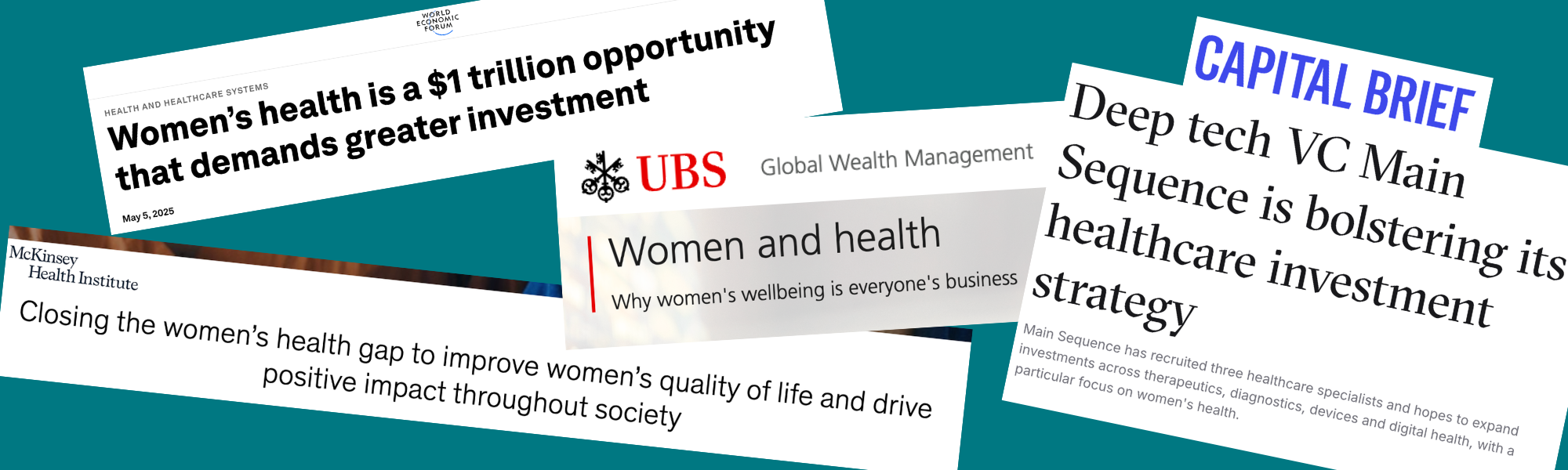
The WEF estimates that closing the women’s health gap represents a US$1 trillion annual opportunity by 2040. Even more striking: every US$1 invested could generate US$3 in economic growth. Closing the gap could prevent 24 million years lost to ill health. The impact is not abstract– it is measurable at a national level. In Australia, improving the accuracy and speed of diagnosing ischaemic stroke in women to match that of men would save approximately $2,984 per patient, translating to $5.4 million in national savings. Multiply this across other conditions where women are underdiagnosed or undertreated, and the economic case becomes undeniable. Very few economic reforms offer that scale of return, yet capital allocation tells a different story.
Around 90% of funding in women’s health flows into just three areas: cancers, reproductive health and maternal health. While these are essential fields, they only represent a fraction of the overall disease burden that women carry. Cardiovascular disease, autoimmune disorders, chronic pain, menopause, metabolic conditions and mental health remain comparatively underfunded, despite being more common and having a significant workforce impact.
This is not just a healthcare inefficiency. It is a productivity drag.
The Cost of Inaction
In most populations, women experience more chronic, non-fatal conditions than men and spend more years living with disability. The McKinsey Health Institute estimates that nearly half of this burden falls on women of working age. The consequences compound over decades.
Health challenges affect career progression, leadership pathways and earning trajectories. Lower earnings translate into lower savings and reduced investment accumulation. At the same time, women face higher cumulative medical costs and must stretch retirement savings further because they live longer on average. As the “Women and Health” report by UBS puts it, “women earn less, pay more and stretch further.”
That gap is not only personal. It is systemic. When a significant portion of the workforce is managing underdiagnosed or poorly treated conditions, national productivity suffers. Talent leaves early. Working hours are reduced. Informal caregiving rises. Economic growth slows quietly and structurally. And yet, we have proof that when science, policy and reimbursement align, women’s health markets scale.
The Blueprint for Scaling

Image: Freepik
The IVF industry shows what happens when science matures, reimbursement aligns, and demand is recognised. What began in 1978 as experimental medicine is now a multibillion-dollar global sector, responsible for more than 12 million births globally. It did not scale because it was niche; it scaled because policy, pricing and scientific reliability converged. The next wave of growth across women’s health could be even larger.
But structural distortions remain. Latest research in the Journal of Women’s Health and the BMJ highlights that procedures for men are reimbursed at rates roughly 30% higher than those for women. Lower reimbursement dampens hospital incentives and research prioritisation. Markets respond to price signals, and right now, those signals remain skewed.
The WHAM report estimates that US$350 million invested in women-focused research could yield US$14 billion in economic returns. Doubling research investment in women and coronary artery disease alone could save nearly US$2 billion in healthcare costs. Thesere significantly more than just marginal gains.
The Next Frontier
For investors, women’s health sits at the intersection of AI diagnostics, biotechnology, medtech, digital health and advanced manufacturing. For governments, it represents increased workforce participation, reduced long-term healthcare expenditure and stronger productivity growth. For superannuation funds and employers, it directly influences lifetime earnings, retirement adequacy and talent retention.
The countries that treat women’s health as a strategic growth sector, aligning research funding, procurement policy, reimbursement reform and private capital, will build globally competitive health industries. Those who continue to treat it as a subcategory or “niche” will import the innovation later. Women’s health is not a boutique vertical. It is one of the largest underleveraged economic opportunities of our time.
If you want to support Women's Health startups, get in touch, send us an email to founders@unsw.edu.au
We’d love to hear from you!
OR if you are building one… Apply for our Health 10x program!